
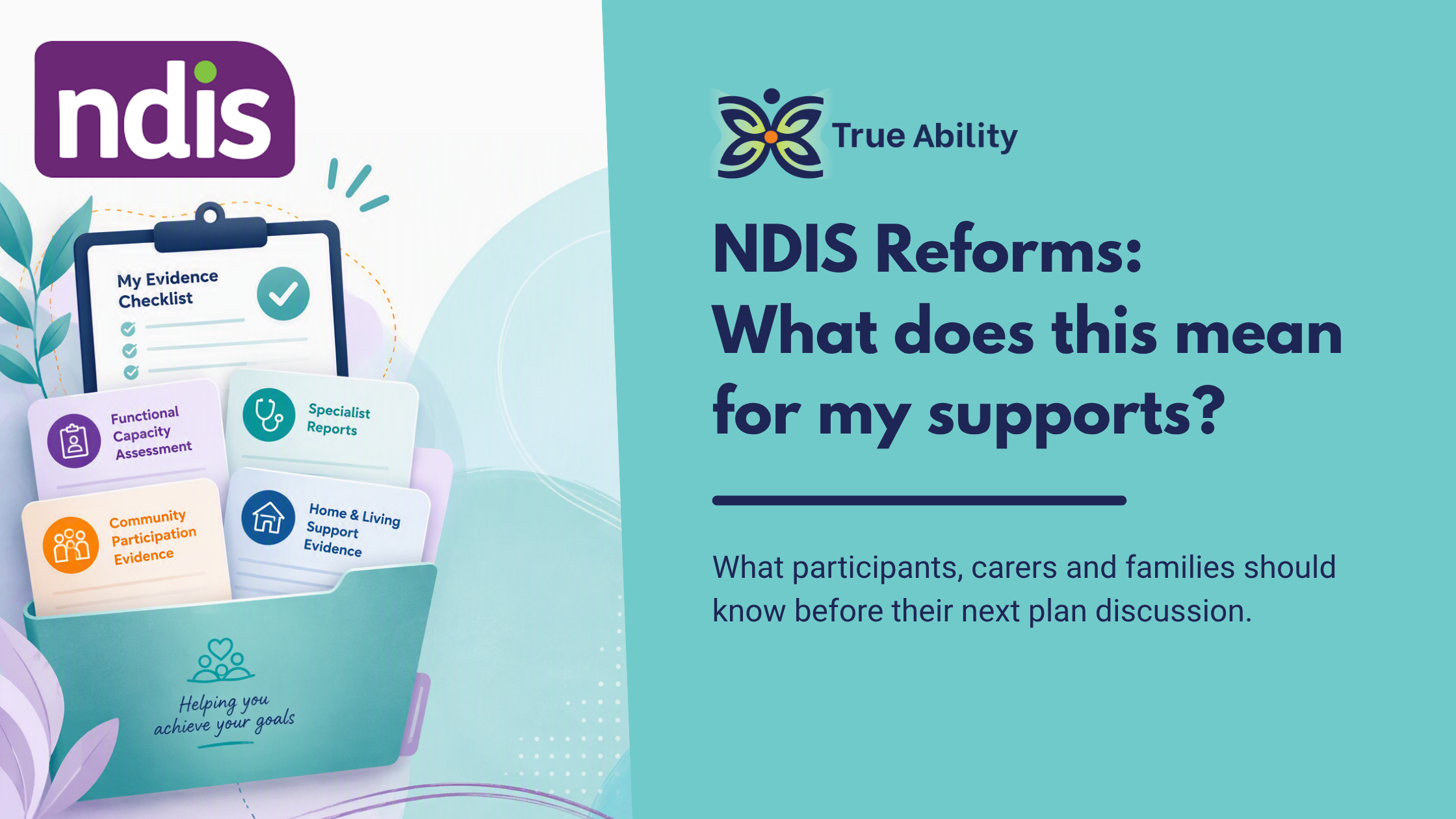
A clear checklist for participants, families and carers as NDIS reforms continue.
 Download Easy Read version here
The NDIS rules and processes are changing. People with disabilities are being asked to provide more evidence along with their motivation (documented reasons) for why their supports are reasonable, necessary, and help them work towards achieving their NDIS goals.
Important to note: You do not need to wait for every reform detail before checking
whether your supporting information still reflects your current needs.
All funding decisions are individual. The NDIA considers the evidence provided and
tests all requested supports against the reasonable and necessary criteria.
Current, specific reports make support needs easier to understand, but they do
not guarantee funding.
A quick reform timeline
|
DATE |
WHAT CHANGED |
|
October 2024 |
Changes began across access, planning, funding periods and the way NDIS funds may be used. |
|
1 July 2026 |
Mandatory registration and new claim arrangements commenced for SIL providers. |
|
18 August 2026 |
The next reform legislation passed Parliament. Further details will continue through rules, consultation and implementation. |
|
27 August 2026 |
New NDIS rules introduced affecting how plans are reviewed, how records must be kept, and how providers operate, with a stronger focus on compliance, fraud prevention and sustainability. |
|
1 October 2026 |
Existing unregistered SIL providers must have applied for registrationto continue delivering SIL during the transition. |
Start with function, not just diagnosis
A diagnosis identifies a condition. Supporting evidence also needs to show its
practical impact on your daily life. Reports should state what assistance is required, when it is
required, how frequently it is needed and how the recommended support relates
to the diagnosed disability needs and goals.
Who can provide evidence?
Use the professional best placed to comment on the issue being considered. This
may include a GP, paediatrician, occupational therapist, psychologist,
psychiatrist, speech pathologist, physiotherapist or another relevant treating
professional. The NDIS states evidence should be recent, original, specific to
the participant and provided by an appropriate qualified professional.
Examples include an occupational therapy functional assessment for day-to-day
functioning, or an updated paediatric or developmental report where a child’s / participant’s
needs, function or treatment have changed.
What should the report cover?
- Current functional capacity across the areas relevant to the request.
- Tasks completed independently, with support, or not safely completed.
- The exact type, frequency and timing of assistance required.
- Changes since the previous plan or assessment.
- Risks and likely consequences if assistance is not provided.
- The participant’s goals and the expected outcome of the recommended support.
- Other supports already available and why they do not fully meet the
disability-related need. - Incident reports highlighting the need for increased supports and/or change in supports
Match the evidence to the support
Social and community participation
Document the activity or goal, the disability-related barrier and the assistance
required to participate. This may include prompting, communication support,
skill development, safe access or help making choices. Include how often the
support is needed and why informal or ordinary community options are insufficient
by themselves.
Assistance with daily life
Describe a normal day. Record the help required for personal care, meals,
household tasks, routines, mobility, medication, communication or supervision.
State the frequency, duration and level of assistance, together with any safety
or wellbeing consequences when support is unavailable.
Supported Independent Living and home supports
Home and living evidence should set out daily and housing-related support needs,
including when and how often assistance is required. It should explain functional
impacts and identify other living or support options considered, including why
those options do not meet the participant’s disability-related needs. Where needs
or goals have changed, the NDIS says the evidence should be dated after the last
plan approval and explain the change in function and daily support requirements.
Before a plan discussion
- Collect recent reports and note when each report was completed.
- Write down changes in daily routines, risks, goals or informal support.
- Check that recommendations include hours, frequency or intensity where relevant.
- Bring examples from everyday life that show the impact of the disability (incident reports).
- Ask your treating professional to explain the reason for each recommendation,
not only list a support.
Useful NDIS resources
- NDIS: How to gather evidence
- NDIS: What is reasonable and necessary
- NDIS: How to ask for home and living supports
- NDIS: What is supported independent living
- Department of Health: 2026 NDIS legislation changes
- NDIS Commission: Mandatory registration
Discuss your support needs
If your needs have changed or a plan discussion is approaching, contact your
True Ability coordinator. We can review the service information we hold, talk
through your current supports and help you prepare questions for your treating
professionals, Support Coordinator or the NDIA. Clinical recommendations and
funding decisions remain the responsibility of the relevant professionals and
the NDIA.
Phone: 03 7009 1557
Email: admin@trueability.com.au
We are here to support you every step of the way, and are already preparing reports and guidance documents to strengthen your application with evidence based on your NDIS support needs.
Sources
Information checked against official NDIS and Australian Government resources
current as published on 24 August 2026. When preparing for a plan change or review, confirm
requirements for your individual circumstances with the NDIA or your Support Coordinator or Plan Manager.
- NDIS: How to gather evidence
- NDIS: What is reasonable and necessary
- NDIS: How to ask for home and living supports
- NDIS: What is supported independent living
- NDIS: Changes to the NDIS
- NDIS: Summary of legislation changes
- Department of Health: 2026 NDIS legislation changes
- NDIS Commission: Mandatory registration